

Actividad reciente
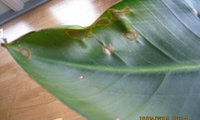

Its xanthomonas. bacterial disease. quite serious. it can reach anthurium and orchids by water contact. the better is to burn it. sorrowfull but too dangerous for orher plants.

Bacterial leaf spot diseases are initially wet and usually limited at first from expanding beyond leaf venation, making the lesions angular or irregular, while lesions associated with fungal infections are dry and uninhibited from expansion across venation.
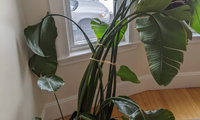

Repot her and give her your spent coffee grinds...and turn her weekly!
Forum discussions frequently center on the question of adding dilute coffee/tea or grounds to plants as a 'tonic', but Arabica (coffee) and Camellia (tea) are known for their toxic alkaloid (caffeine) content and their allelopathic affect on plants as well as autotoxic (poison to their own seedlings) effects on future generations. Caffeine interferes with root development by impairing protein metabolism. This affects activity of an important bio-compound (PPO) and lignification (the process of becoming woody), crucial steps for root formation.
We also know that the tannins in both coffee and tea are known allelopaths (growth inhibitors). There are ongoing experiments to develop herbicides using extracts from both coffee and tea that cause me to want to say they might serve better as a nonselective herbicide than as a tonic. I would not use either (stale coffee or tea) by applying directly to my plants - especially containerized plants; nor would I add tea bags/coffee grounds to my container soils.
Miss you Al, Thanks for all the info, You are a Master Gardener in my eyes.
I'm still around, enjoying nature and life in general, and still active in the gardening/ bonsai community. Thank you for your expression of such kind words, Lynn.
Friends helping themselves to an offering of sunflower seeds.
Al