
Actividad reciente

I’d grow it for the foliage…if I could…which I can’t. I miss Ken.
This is purely out of curiosity, but how does it do in Portland? What would you expect the growth rate to be? Maximum expected height?

I researched Machilus thunbergii in the past, since I was interested in broadleaf evergreen trees that could grow in the Pacific Northwest (climate zone 8 ).
It is actually native to Japan. But in Japan, it is sort of seen as an "inferior" version of camphor tree. However, Machilus thunbergii is more cold tolerant than camphor tree, and can grow in colder parts of Japan; although the majority of the population in Japan (such as in Tokyo) lives in areas where camphor trees can grow.
The foliage of Machilus thunbergii reminds one a little bit of some Chinese evergreen magnolia trees (which are rare in cultivation, but not completely unheard of in the U.S.)
There is also "Japanese cinnamon" tree (Cinnamomum tenuifolium) for anyone who is interested (though it is a smaller tree, and evergreen leaves not as pretty).

I don't know why the Japanese would complain - they have plenty of BLEs and a summer wet climate that supports them. The hardiest Cinnamomums are surely as hardy as any Machilus, but they might not be commonly cultivated in Japan. It's actually a little surprising that Japanese gardeners (vs. forest managers or whatever) like camphor trees, because they get so gigantic! I think of gardens there as being smallish.
Honestly, on showiness alone, the flowering Castanopsis of Japan might be prettier than any Cinnamon or Avocado family member! I ONCE AGAIN failed with the Castanopsis seeds Sheffield was offering...not sure what I'm doing wrong, and feel like an idiot at this point. At least I got some other rarities to germinate, like Pinus gerardiana, and Nomocharis aperta. 3 out of 15 seedlings survived in trays this summer, so hopefully I've selected a 'heat tolerant' clone of that Himalayan beauty! (the lily seed was from Jelitto, not Sheffields)
"we're very lucky to live in a place where anything will grow, whether it likes water or not. For those types that need regular water, just add it and stand back!".
Yeah, now, I'm 'used to' a summer wet (usually) climate, which isn't to say I'm not jealous of what people can grow in the PNW. But the problem with a summer wet climate is you can't turn it off! The reason one saw rhododendrons growing near the bottom of swales at Greer Gardens, (or Sonoma Hort for that matter) where they would never be able to survive around here, isn't JUST the cooler nights in summer...it's that because any summer water is water you're turning on, yourself, there's no way to drown them as can happen around here after a hurricane. As I've said before, around Hurricane Irene in 2011, I got close to 30 inches of rain in 40 days. It did kill a few rhododendrons (including a big gorgeous R. rex I'd driven across the country from RSF) but fortunately, most of mine are planted on a gentle slope and it prevented an absolute carnage. They get just enough drainage help from that. This was really a happy accident, when I bought this lot in 2006, I had no idea I'd get 'smitten' by rhodies by driving to Rarefind in NJ that spring. I never knew you could have an 'english looking' rhodie garden in the eastern US. (FWIW Rarefind was on pine barren sand, and had a very sophisticated irrigation system with a deep well and large pump house, so actually closer in that respect to the PNW, than my garden.)
OH well, sorry to take over the thread, but it's interesting to compare gardening practices PNW vs. East coast. I love the summers I can coast by without having to water a damn thing even once, even newly planted stuff. But we pay the price when the spigot won't shut off! (And of course, have to water in dry summers like 2024 and 2025.)
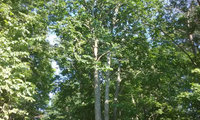
Sugarberry (Celtis)

Tilia americana var. heterophylla native range map:
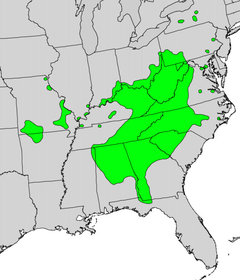

Arbordave, when I lived in southwest VA, the northern basswood is replaced by the white basswood. It's similar to the the buckeyes having an Ohio (northern) buckeye and a southern Appalachian form, the yellow buckeye. The white basswood became obvious when the white leaf-undersides flagged in the wind, like a silver maple.
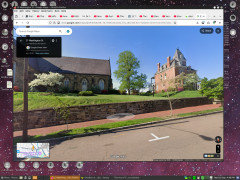
And just today in downtown Cumberland MD, I got an up-close look of a very large and beautiful European little-leaf linden in a churchyard. Didn't have a camera, but here's a long-distance street view dated in the spring.
“Seem to be a smaller denser version of Hortsmann Silberlocke.”
That’s not surprising since it originated from a seedling of ’Horstmann’s Silberlocke’. ’Icebreaker’ was also found as a mutation on ’Horstmann’s Silberlocke’. Of these two, ’Silver Show’ will be closer in size and growth rate to Silberlocke.
There’s no right or wrong to planting a larger size, but there is a real sense of satisfaction seeing a small plant slowly make itself into a nice specimen.
I am fond of all Korean Firs and have several in my garden. Here’s the species:
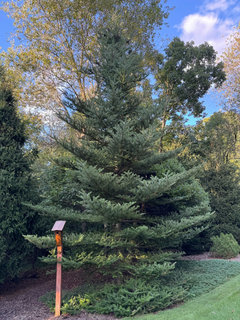
Horstmann’s Silberlocke:
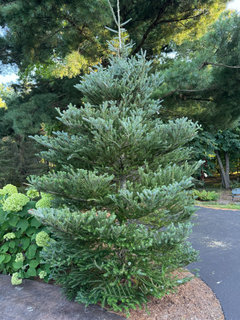
Icebreaker #1:
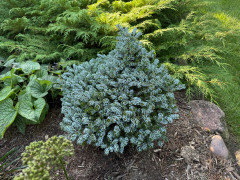
Icebreaker #2:
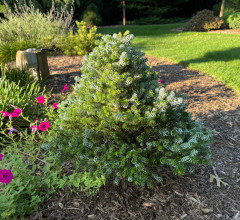
Silver Show: (3gal. yet to be planted)
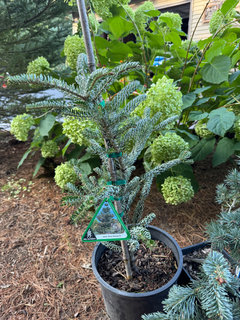
Is anyone familar with the cultivar Frosty. I found a few mumblings online but nothing I would definitive on the traits of this cultivar.
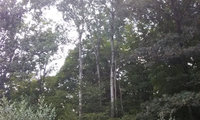
The picture isn't real clear, but the lower bark looks to be furrowed, while the upper part of the trunk is smooth, similar to tremuloides. This is characteristic of this species in my part of the world. They also tend to grow on drier sites than tremuloides.
UBG, when I was attending VA Tech in Blacksburg, VA, there was an empty field near the city limit where a huge white poplar grew (Populus alba) and was surrounded by a sea of 15-20 ft tall suckers -- must have been a hundred of them.
PS Jay 6A, there's at least 2 Populus alba near me that I see regularly, one a medium tree and another a copse of suckers from an apparently cut stump. The tree gets the typical autumn leaf-blight....

We had mature Populus alba growing as a specimen tree in the front yard next door to where I grew up.
The suckers were aways 2-3x as tall as the grass and evenly distributed in a large radius (100 ft?) around that tree, every time dad mowed the grass.
iirc: There were 'scalped' roots showing, above ground, in the immediate area around that tree.
In the wild, many trees begin life in the understory of the parent trees.
When I first started planting here, in my treeless yard, all of my plantings suffered to some extent, under direct, all day (<=15 hrs) sun.
Everything I've planted more recently, is doing better now that many of my originaly planted trees are large enough to produce a certain amount of shade at various times of the day.
It will be interesting to see how well the little abies will handle the dense, established root system of a mature white pine.
I too am a bit skeptical about how it will perform under this pine. If adequate moisture is the test, then I think it will work — at least in the relatively short run (5-10 years). If other factors (i.e. root congestion) come into play, then it will likely be a failed experiment. It could all be moot if deer find it to their liking. The good news is Abies are generally not their favorite browse.