

Actividad reciente


Define 'hardy'.
About 30 years ago, someone sent me a rooted cutting. For all I know, it is still out there, though I don't think I've seen it in the last five years. It has produced a flower or two along the way. I think it may have been a foot tall once,
So if by 'hardy' you mean does not die, 5b is perfectly reasonable. If by 'hardy' you mean becomes a reasonble specimen, its a lot warmer than here.

Malcolm, I'm 7b, so normally much warmer than your area, but Maggie has come through a couple of abnormal winters, i.e., sub-zero Arctic Express winters with days of relentless dry winds. Maggie shrugged it off, very hardy for a (possible) bengale/china (or is she a bourbon?). I can't say she'd endure a full winter of that stuff, but she doesn't mind the occasional dip below 0.
Where are you? Your location makes a world of difference as to what roses will do well for you. And are you no-spray? That probably is the biggest consideration besides hardiness of the rose. What size rose are you looking for? Low growing, or would you consider a climber? "Favorite white rose" is a little broad, lol.

I imagine the discussion at hand is about repeating roses, but my favorite white rose -- indeed, one of my favorite roses -- is 'Madame Hardy'. Simply unmatched, for bloom form, and a lovely scent and good health as well.
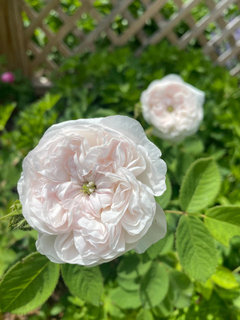

My favorite white rose is Pope John Paul 2. It also happens to be the Saddleback Caterpillars favorite. I have been badly stung more than once, by the little greedy guts hiding underneath the leaves. They blend right in. Its okay, they can have the leaves, I will take the blooms. It blooms often and smells heavenly. It does get a little black spot but I wouldnt be without it.

There was intentional spread of RRv by USDA folks (Maryland, into is in a plant pathology note) after the activities of Epstein and Hill at Iowa State.
Beef farmers in southern Iowa were trying to cheaply eradicate multiflora in their farms. Once rose rosette was found in one county in southern Iowa, it could be tested elsewhere in that state.
The first paper by Staple, Allington and Viehmeyer describes what they found in Nebraska, before the activity of Epstein and Hill. Epstein and Hill wrote in a juried publication that RRD seldom infected cultivated roses. IMO their four test plots were somewhat mis interpreted: several were eaten by hungry deer over winter, one may bave been destroyed by a flood and the other included Color Magic which seldom survives winter even in my warm zone.
Mark and a number of other scientists benefitted from USDA research funds. The scientists at U Arkansas are the ones who isolated it as a virus and who created the dendrograms that show its relation to other Ermara viruses named for the European Mountain Ash Ringspot Associated virus.
FWIW, I bought 'William Shakespreare 2000' the first year Pickering offered it and grew it in a large pot for the first two years. It was an odd grower; reluctant to make much progress, and most of it's growth was horizontal. Year three I moved it out into a good location in the garden and it struggled along for 2 more years and the next spring it was dead — no indications as to why it failed. I never bothered to replace it.
I've complained about 'The Prince' and its idiosyncrasies (awkward growth habit, lack of vigor, loves to Blackspot) but twenty-five years after acquiring 'WS 2000' I still have 'The Prince' and not 'WS 2000', and 'The Prince' has actually performed better this year than at any other time in the 30+ years I have had it. It seems that it thrives in a LARGE pot on a deck, sheltered from the hot afternoon sun (but in very open shade) and as long as I keep the Diplocarpon rosae away, it does quite well. (It's growing on its own roots, which seems to suit it. The original plant was grafted and it performed no better than on its own roots)
'The Prince'